I’ve long admired the character of Sherlock Holmes, ever since I first picked up a book by Sir Arthur Conan Doyle as a young student. It would take me just a few days to gobble up a whole Conan Doyle book! While Holmes’s analytical brilliance always captivated me, it was his keen sense of empathy that truly resonated with me. The way he effortlessly read people, connected the dots and solved intricate mysteries with such ease sparked a deep interest in being a 'professional detective'!
As I pursue my passion and continue my journey as a UX Practitioner, as a little fanboy I still manage to become a detective - occasionally :D ... here is how!
The discovery phase
For me, the most exciting part of a UX design project is the ‘Discovery’ phase, where uncertainty overshadows the whole team, and the team is anxious to piece together clues and insights to solve the puzzle that is user experience. One of the least documented activities that could do wonders and set the tone for the design directions is - ‘Competitive Benchmarking / Competitive Analysis’. This activity is especially handy when you are working on a product/tool which has competition in the market which you would want to compare/analyze and draw insights from to improve your own.
In the past 20 years as an Enterprise UX practitioner, I’ve been part of countless 'Competitive Analysis' exercises, and each had its unique learnings; the most valuable being the need to be contextually aware! Each instance brings its challenges and demands, and it’s necessary to understand the base need and plan accordingly.
Here are my 5 key takeaways from conducting a successful competitive analysis that could put you and the team in the driver’s seat
Start from the end
Is the research team onboard?
What are you comparing?
Which framework/tools to use?
Provide recommendations
Avoid confirmation bias
Start from the end
Have the endpoint in mind. Where would the output of your competitive research end up?
Is it just a presentation destined to fade to oblivion along with numerous others?
Is this going to be a baseline for the team's research efforts?
Is the team trying to identify gaps in the system with the help of this exercise?
Is the team trying to identify potential threats from competitors?
Is the team trying to identify consumer behaviour shifts and strategize accordingly?
This understanding is crucial to laying out the foundation and planning for the efforts involved.
Starting from selecting the competitors to defining the areas of analysis ( branding, tech stack, accessibility, CX ++ ), this clarity of thought helps with a vital piece - avoiding analysis paralysis!
Is the research team onboard?
Depending on the maturity of your design team, this one is a differentiator!
Even if you are involving the lone researcher in your team part-time in this effort you would have gone far enough into a job well done! I feel lucky to have had a chance to work with some awesome researchers like Veronica Shimanovskaya, DFA Peter Frasca and Lavrentia Karamaniola, PhD . These folks are process machines and help tremendously to bring in different levels of rigour in the exercise and the output speaks for itself!
Some key benefits of involving your research team IMHO:
Rigorous data collection
Perform targeted research to gather actionable insights and key metrics
Methodological Rigor
Objective Analysis
Identify and mitigate biases
If you have a research team, definitely involve them. If not, no worries—select a design team member with a strong interest in research and have them step into the role of researcher for this exercise!
What are you comparing?
This is the most important piece of the puzzle. Its vital to have clarity on what is being compared, in addition to the objective of the exercise. Often the pitfall is in identifying the right factors to analyse/compare. Here are some common areas to get started
Are you comparing product features?
Are you comparing usability?
Are you comparing market presence?
Are you comparing omnichannel strategies?
Are you comparing accessibility?
Are you comparing CX?
Which framework/visualization to use?
There are plenty of frameworks out there, but trust me—if you haven’t nailed down the last three parts, using any framework will be a wasted effort. Each framework serves different objectives, and without a clear understanding of why you’re doing this exercise, you could easily choose the wrong one.
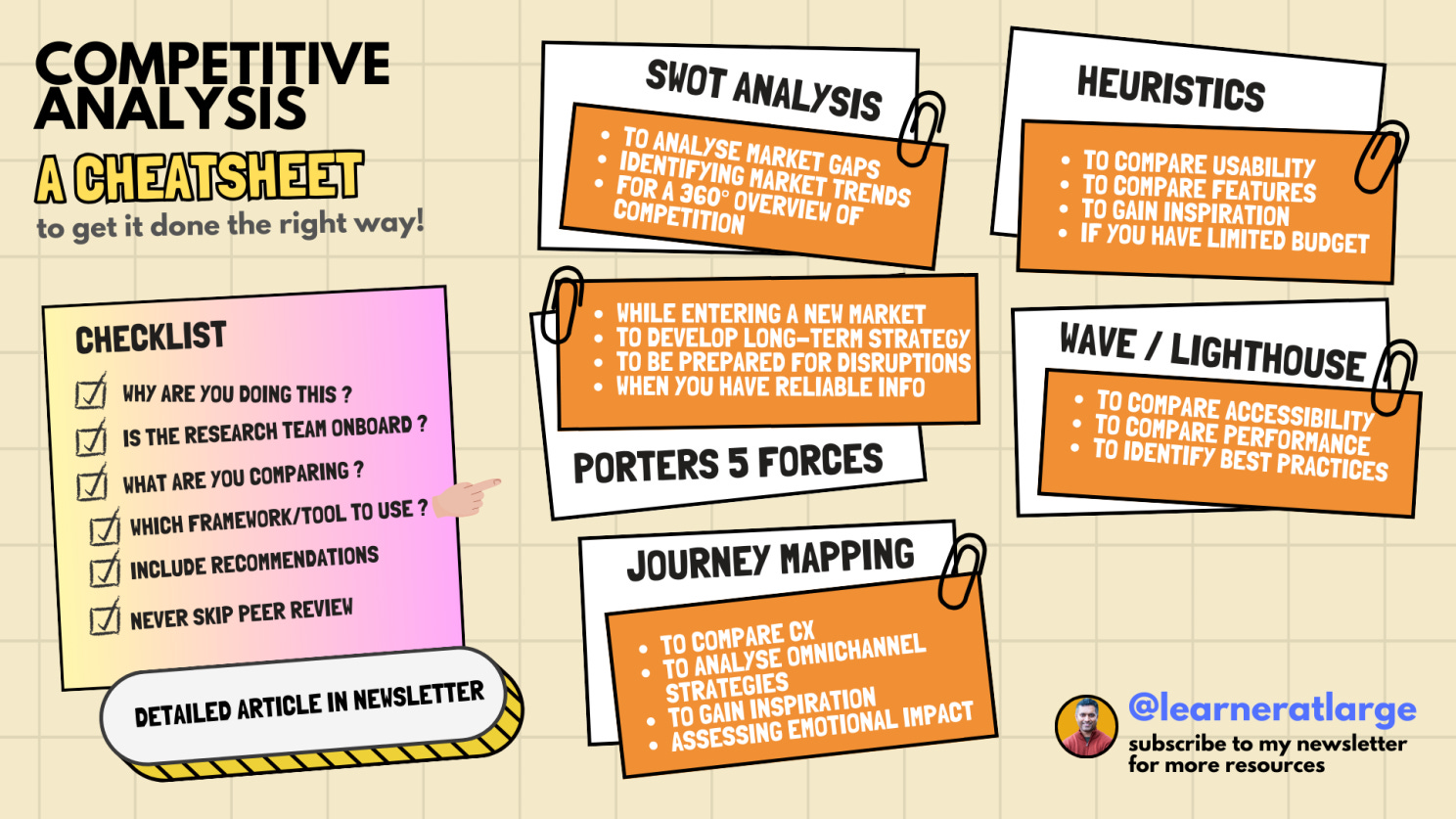
Although a quick search can reveal countless frameworks, here’s an 'objective-to-framework' mapping based on my years of experience. I highly recommend keeping this handy as a reference to help you choose the right framework for your next competitive analysis.
Avoid confirmation bias
Confirmation bias is real! IMHO this is a most-overlooked area and most designers ignore this factor.
Introduce peer-review rounds at critical stages ( but be sure not to fall into the trap of 'paralysis by analysis' )
Adoption of the right framework/checklist can also tremendously contain the ill effects of 'Confirmation Bias'
Bookmark / Save this article and next time you think about getting a competitive analysis done, do it the right way!