Maslow’s — ‘Hierarchy of Needs’
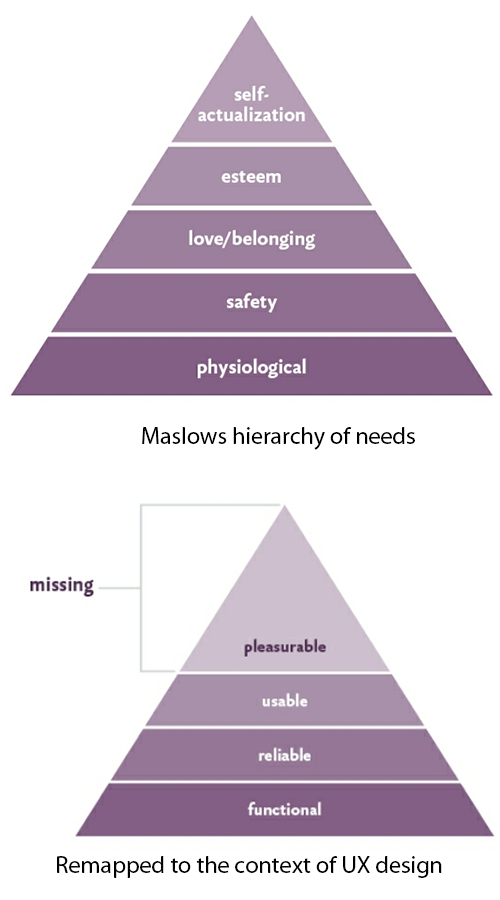
The holy-grail every digital experience designer is after, has something to do with Maslow’s — ‘Hierarchy of Needs’, and its contextualisation to UX design!
While building a usable product has been the focus historically, ‘pleasurable’ experiences are what makes the user come back to the product frequently and leaves them craving for more.
Fitts’ Law
The amount of time required for a person to move a pointer (e.g., mouse cursor) to a target area is a function of the distance to the target divided by the size of the target. Thus, the longer the distance and the smaller the target’s size, the longer it takes
MT=a + b * log2(D/W + 1)
Dropdown menus, Position of Status bars, Call to action proximities, Fitts’ law is everywhere in the GUI world!

Garbage In, Garbage Out (GIGO)
The quality of the system output is largely dependent on the quality of the system input
One of the universal principles of design, GIGO has great relevance in digital experience design world.
A simple instance of this principle can be found in form validations, where the quality of input is being validated before it reaches the system and generates an output. Underlining factor is that, well designed systems are the ones which avoids wrongly input being fed into the system without the much effort from the user.
Hick’s Law
The time it takes to make a decision increases as the number of alternatives increases.

Although the actual examination done by William Edmund Hick and Ray Hyman in 1952 had to do with number alternate stimuli present and reaction time to any given stimulus, this law is as relevant as ever in this age where users are bombarded with choices of all kinds!
Interaction design, Information Architecture, Visual design and even in daily life this is a gem of an observation and principle to follow and comply with.
Simplicity of Google search or Tumblr for instance are classic examples of how Hick’s law is relevant in the digital experience design world.
The Hook Model
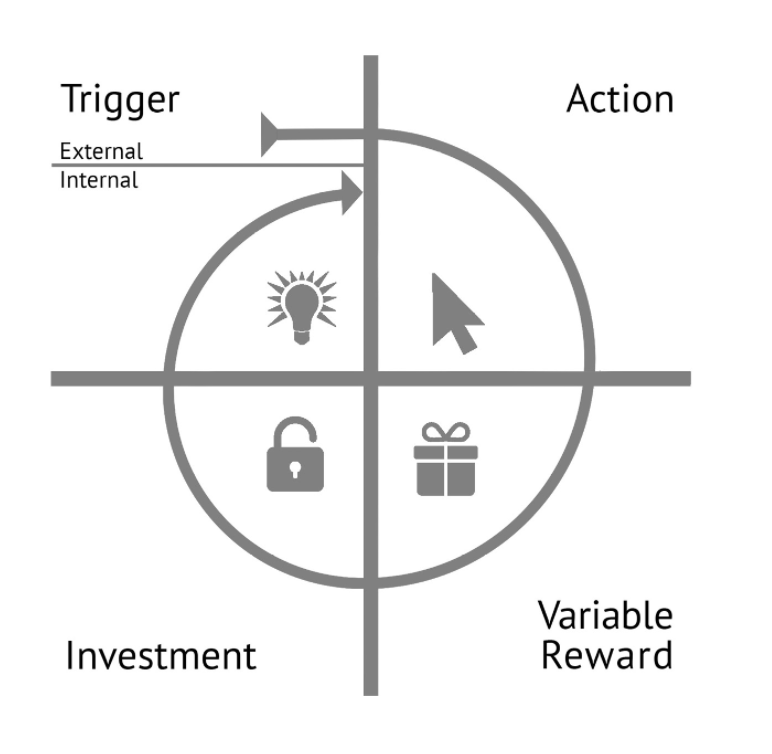
A Framework conceptualised by Nir Eyal in his book ‘Hooked’, this model promises to hand-hold any team looking to build habit-forming products, to the door-steps of success.
With the gist of this model packed into four core principles: “Trigger . Action . Variable . Reward . Investment”, this framework clearly lays down foundations and directions to influence user behaviour and keep them hooked to the product!
Priming
Priming happens when a person is exposed to a stimulus that in turn shapes their response to another stimulus
A leaf borrowed from principles of psychology, priming applies to interaction design beautifully and to behavioural design much more closely.
What Twitter did to launch its 2010 redesign has ‘Priming’ written all over it. They shared glimpses of the new design on Dribbble much before the launch date, and created a positive hype and anticipation which eventually led to a successful launch later on! How prime!
Customer Lifetime Value (CLTV)
The amount of money made from a customer before that person switches to a competitor, stops using the product, or dies.
An interesting term from Nir Eyal’s ‘Hooked’, this opens up avenues related to consumer habits and brand values!
Are you building a painkiller or a vitamin?
Building a new product and releasing it to the market needs funds, and Investors are the first stakeholders who becomes vital for any product’s launch. This is a key question any investor asks to judge the worthiness of his investment.
Painkillers solve an obvious need, relieving a specific pain, and often have quantifiable markets.
As a Digital Experience Designer, one can take a leaf from this idea and introduce this question to your market research / user research activities too…
When material design crosses your path…
Some quick links and resources to help quickly get started with a material design UX design project
- https://material.io/
- https://material.io/color/#!/
- https://www.sketchappsources.com/free-source/874-material-design-google-sketch-freebie-resource.html